
Clogged Drain Repair in Kyle, TX
Most blocked drains are not mysteries. They are hair, grease, wipes or roots, sitting in a place we can name before we arrive if you tell us which fixtures are misbehaving.
Call (737) 385-7666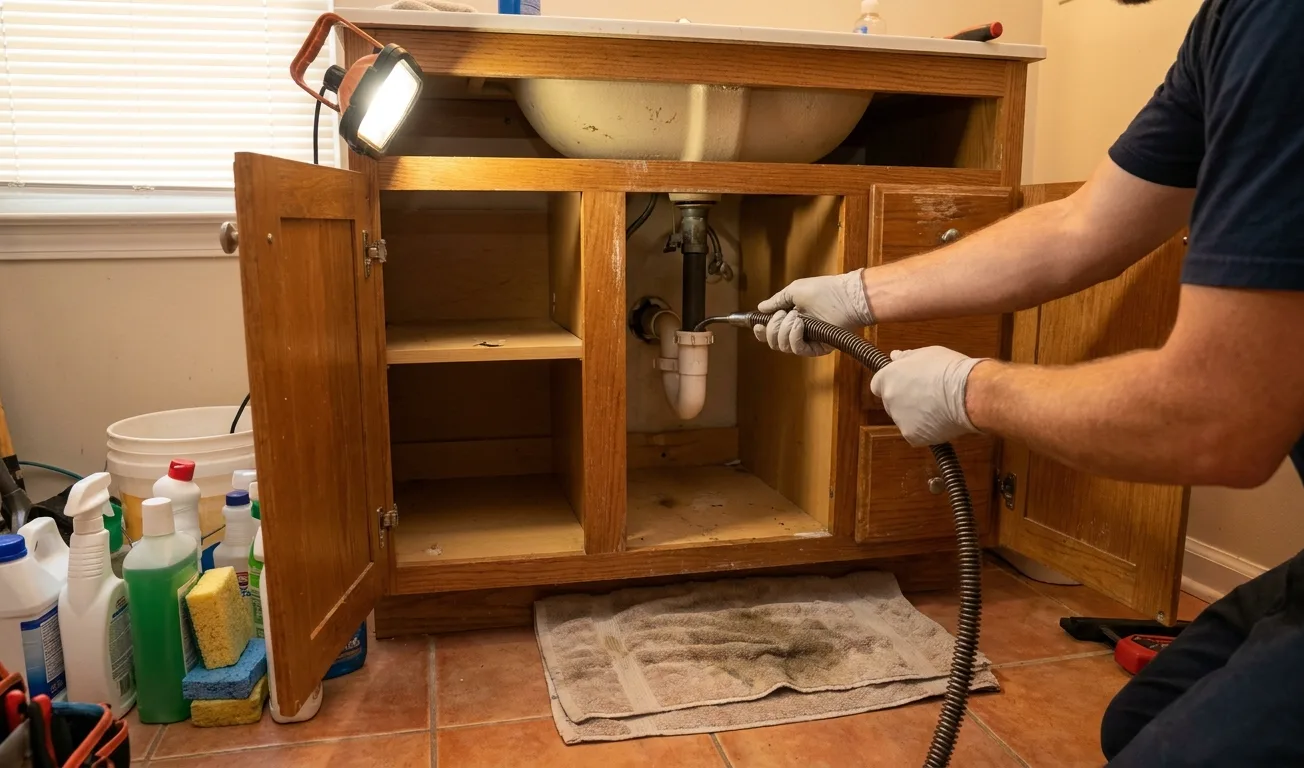
Reading the symptoms before anyone opens a pipe
Which fixtures are affected is more informative than how badly they are affected. Drainage is a tree: everything joins a branch, branches join a stack, the stack joins the lateral out to the street. Whatever has stopped sits below the lowest thing that is misbehaving and above the highest thing that is still fine.
That really is the whole method. It sounds too simple to be worth much and it is right nearly every time.
- Basin slow, everything else fine — the trap or the short arm behind the wall. Feet, not yards.
- Bath and basin both slow — below the point those two meet, typically inside the bathroom wall.
- Toilet rises when the shower runs — you are already past branch trouble and into the stack or the lateral.
- Washing machine discharge floods a floor drain — a washer dumps faster than any other appliance, so a main line that is half blocked shows there first.
How we clear it
The size of the cable and the size of the cutting head are chosen for the pipe, not for the truck's convenience. A 3/8-inch cable belongs in a 1½-inch basin arm; putting the big sectional machine down there is how a technician ends up buying a homeowner a new trap.
Work runs through the nearest sensible access — a cleanout where there is one, otherwise a pulled trap or a lifted toilet, with drop cloths down first. Where a house has no exterior cleanout at all, we will say so and explain what fitting one would involve, because it changes the cost of every future visit rather than just this one.
- Hair and soap in bathroom branches — retrieved rather than pushed further down the line
- Kitchen grease — cabled out, and jetted instead when the coating has narrowed the whole run
- Wipes, cotton buds and toys — the things that call themselves flushable and are not
- Scale and root hair in older galvanised or clay pipe — cut back to the pipe wall, not merely bored through
- Yard and patio drains after a Hill Country downpour — silt, gravel and leaf litter
Why the same drain keeps blocking
A drain that blocks twice in a year has not been unlucky twice. Something structural is holding material up, and the usual culprits are a joint that has pulled apart in the clay, a belly where the line has lost its fall, a root mass regrowing through a crack, or a run that simply was not laid at enough of an angle when the house was built.
None of that is visible from a cable, which is why Drain Cleaning Kyle stops cabling a repeat offender and puts a camera down it instead. Twenty minutes of footage settles an argument that guesswork can keep going for years.
What you can try before you call
Genuinely worth five minutes, and occasionally it saves you the visit entirely:
- Take the trap off under a slow basin. It is two slip nuts and a bucket, and it is where a startling amount of the problem lives.
- Pull the pop-up stopper in a slow bath. The hair collects on the linkage below it and lifts straight out.
- Plunge with the overflow taped shut. Without that, most of your effort goes up and out of the overflow instead of down the pipe.
- Very hot water and washing-up liquid down a sluggish kitchen sink. It will not touch a real obstruction, but it moves a fresh grease film before it hardens.
What is not worth doing is a second bottle of caustic drain opener. If the first one did not work the second will not either, and it turns a straightforward job into one done around a trap full of chemical.
What your drains are probably made of, by the age of the house
Kyle has housing stock from a small nineteenth-century railroad town through to subdivisions finished last year, and the pipe under each of them behaves differently. This is a rule of thumb rather than a survey — plenty of houses have been part-repiped — but it is usually the right starting guess:
Older central Kyle homes
Cast iron waste inside, vitrified clay out to the street. Cast iron scales inward and its bore closes over decades; clay comes in short sections with a joint every few feet, and every one of those joints is a place roots can find.
Mid-century through the 1970s
Cast iron indoors, clay or early plastic outdoors. This is the vintage where we most often find a lateral that is sound in places and failing in others, which is exactly the case a camera settles and a cable cannot.
1980s onward
PVC nearly throughout. Smooth, chemically inert and far kinder to a cable. Its weakness is not the pipe but the ground under it: PVC holds its shape while the soil beneath moves, so it keeps a belly faithfully once one forms.
Recent subdivisions
PVC laid in backfilled trenches that are still settling. Young pipe is not the same as trouble-free pipe — we see construction debris, and fall that was marginal on the day it was laid, in houses barely out of warranty.
This matters on the day because it sets how hard we can work the line. A modern PVC lateral will take a cutting head that would be reckless in eighty-year-old clay, and the right answer in fragile pipe is often a smaller head and more patience rather than more force.
Frequently asked questions
Is there a drain you will not put a cable down?
Yes. If the camera shows a pipe that is cracked through, separated or collapsed, a cable can turn a bad section into a worse one. At that point the honest answer is a repair quote, not another clearing attempt.
How long does clearing a blocked drain take?
A single fixture through good access is typically well under an hour. A main line depends entirely on what is in it and how far along it sits.
Will you make a mess?
Drop cloths go down before anything is opened, and the work area is cleaned and wiped down afterwards. Cable work is dirty by nature — containing it is part of the job, not an extra.
Can you clear a drain without a cleanout?
Yes, by pulling a trap or lifting a toilet. It takes longer and costs more, which is why we will show you where a cleanout could be fitted.
My toilet is blocked. Is that a drain job?
If only that toilet is affected, an auger through the bowl usually does it. If other fixtures are backing up as well, the toilet is the messenger rather than the problem.