
Drain Camera Inspection in Kyle, TX
Everything else on this site is Drain Cleaning Kyle acting on evidence. This is the page about getting the evidence: a camera down the line, on a screen you watch with us, and a recording you keep.
Call (737) 385-7666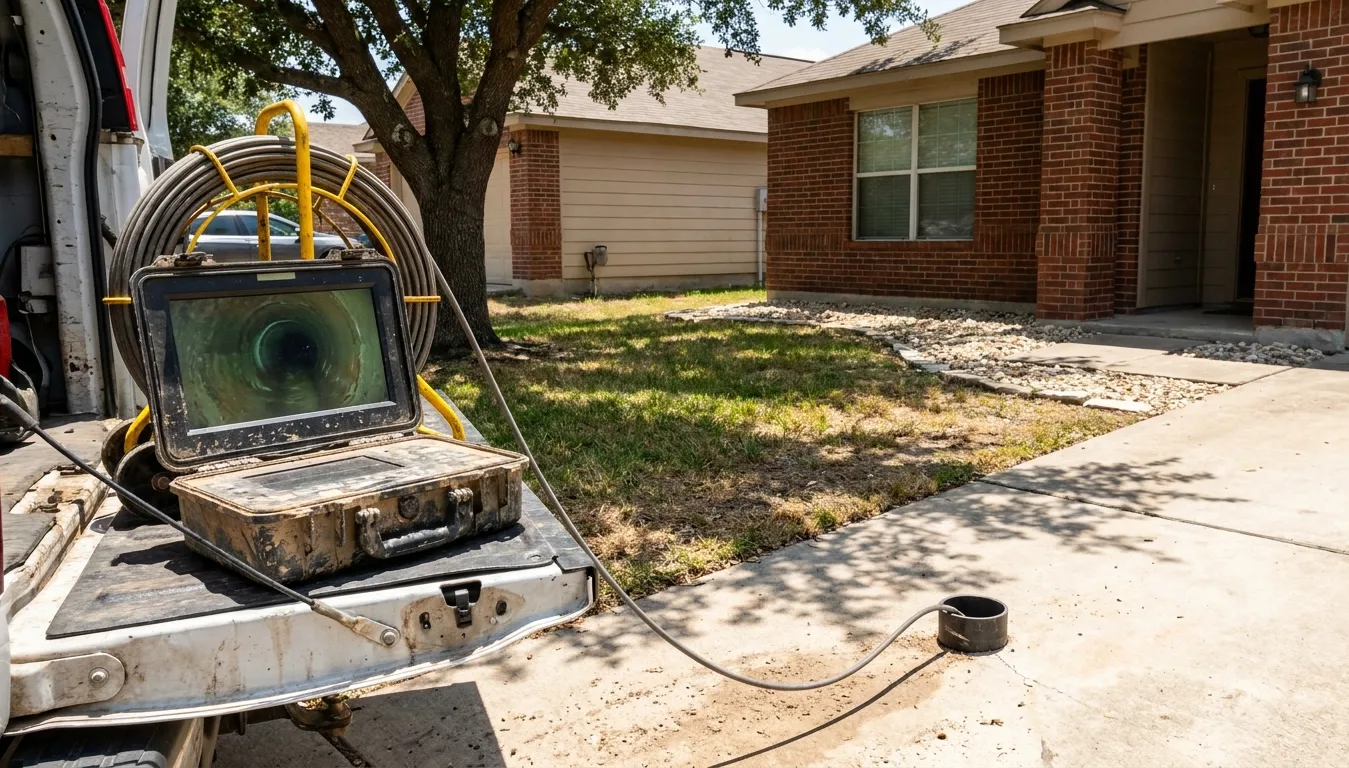
When a survey earns its money
Not every blocked sink needs filming. These are the situations where going in blind costs more than the survey would have:
- A drain that has blocked more than once. Two blockages in a year is a structural message, and cabling it a third time is paying to not find out.
- Before buying a house. A sewer lateral is not covered by a standard inspection, it is one of the more expensive things that can be wrong, and in Kyle's clay it is a genuine risk on properties of any age.
- Before anybody digs. Excavating on a guess is how a homeowner ends up with two holes in a driveway.
- After a backup that reached the house. You want to know whether this was bad luck or the first of a series.
- When a new build is already misbehaving. Construction debris left in a line, and fall that was never right from the day it was laid, are both commoner than anyone likes.
What the footage shows
A camera survey turns opinions into pictures. The faults it distinguishes look nothing alike on screen and feel identical from the end of a cable:
Root intrusion
Fine white or tan hair coming through a joint, or a solid mass filling the bore. You see where it enters, which is what decides whether cutting is enough or the joint needs repairing.
Offset joints
One pipe end standing proud of the next, with a visible ledge across the flow. The clay-movement signature, and easy to miss any other way.
Bellies
The picture goes underwater and stays there. Standing water in a line that should be running downhill means the fall has gone.
Cracks and collapse
Longitudinal splits, missing crown, or soil visible through the pipe wall. This is a repair conversation, not a cleaning one.
Scale and grease
A bore that is visibly smaller than the pipe. Measurable on screen, and the argument for jetting rather than cabling.
Foreign objects and debris
Wipes, tools, offcuts, grout and bagged rubble left in the line by earlier work. More common in newer houses than you would hope.
Locating the fault above ground
Seeing a defect is half of it. The camera head carries a sonde — a small transmitter — and a receiver on the surface picks it up, so a fault can be marked on the lawn or the driveway with its depth noted.
That is what makes a repair quotable rather than exploratory. Instead of trenching along the line hoping to meet the problem, there is a marked spot, a depth, and a hole the size the job actually needs. On a driveway or under mature planting, the difference is substantial.
What you get afterwards
The point of a survey is that you are left holding something you can act on, and can show to somebody else:
- A recording of the run, so a second opinion is a file rather than another visit.
- Distances from the access point to anything worth noting.
- A surface mark and a depth for any defect that will need work.
- A plain-English account of what is urgent, what is worth watching, and what is simply the age of the pipe.
If the line turns out to be sound, that is a perfectly good result and you will be told so. Not every survey needs to find something for the money to have been well spent.
What a camera survey cannot tell you
A survey is the most useful tool we own and it is not an X-ray. Being straight about the limits is part of it being worth anything — these are the questions the footage genuinely cannot answer:
- How much wall thickness is left. A camera sees the inside surface. Corroded cast iron can look tired on film and still have years in it, or look passable and be thin. Nobody can measure remaining wall from a picture.
- Anything past a full blockage. The lens stops where the obstruction does. That is why a line is cleared first and filmed second — the other order simply shows you the back of a clog.
- Anything under standing water. In a belly the camera is submerged and the picture goes green and blank. We can confirm water is standing and roughly where; we cannot see the pipe wall beneath it.
- Leaks on a pressurised water line. A drain camera is for waste pipe. A leak on your incoming supply is a different problem needing different equipment.
- Exactly how bad a slight dip is. A camera reports what it sees from where it happens to be resting. Small grade problems need the sonde and a locator to be called properly, not a confident opinion over a still frame.
Where footage is genuinely inconclusive we will tell you it is inconclusive. “We should watch this and look again” is a legitimate result, and a better one than reading certainty into a picture that does not support it.
Frequently asked questions
How long does a survey take?
For a residential lateral, usually under an hour once the line is clear and the access is open. Locating and marking a defect on the surface adds a little to that.
Can you camera a line that is completely blocked?
Not usefully — the lens sits in standing water and sees nothing. The line is opened first, then filmed. That order is not upselling, it is optics.
Do I get a copy of the video?
Yes. It is your pipe and your evidence, and it is what a second opinion or a repair quote should be based on.
Is a survey worth it before buying a house in Kyle?
On a property where the lateral is old, or where mature trees stand over the run, it is one of the cheaper pieces of due diligence available.
Can you inspect small pipes like a basin waste?
Small-diameter branch lines are usually diagnosed and cleared directly rather than filmed. Camera work belongs in the main line and larger branches, where guessing is expensive.